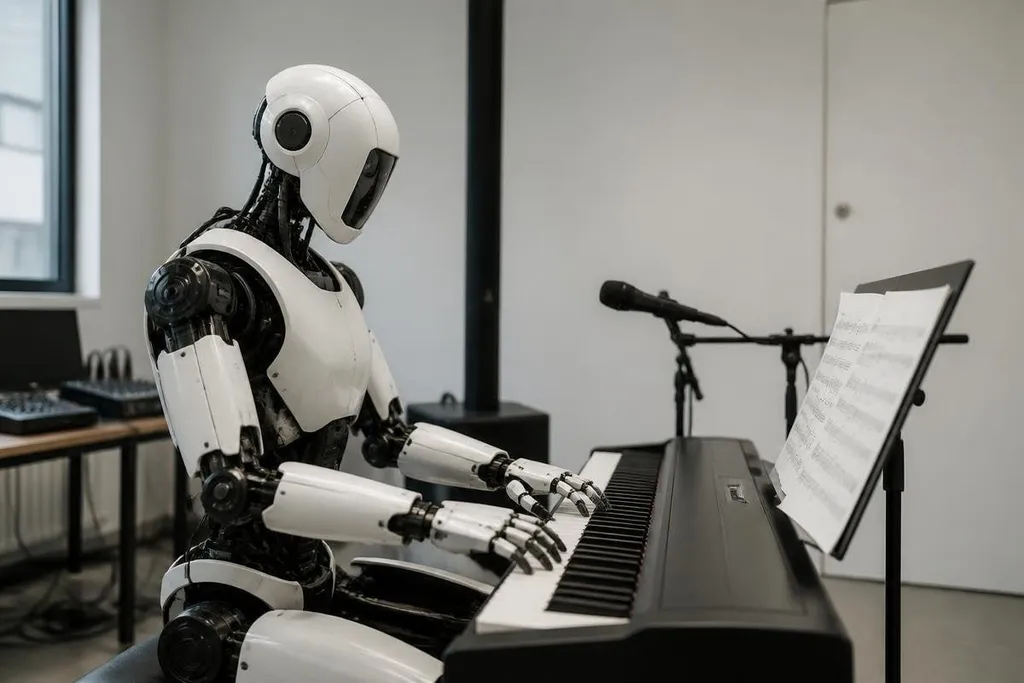
A robot that plays music can follow a score, react to sound, or choose what to play next. Without a supplied evidence pack, the safe answer is a framework for judging those claims, not a list of named machines or verified results.
Quick read
- AI may change how a musical robot hears, plans, and responds.
- A demo proves little until it shows the input, delay, mistakes, and repeatability.
- The useful test is musical control under real timing limits, not a polished clip.
Where AI fits in the robot
A musical robot has several jobs. It must sense what is happening, decide what action to take, and move an instrument with the right timing. AI may sit in any of those steps, but each use creates a different claim.
A sound model could sort notes, beats, voices, or background noise. A planning model could select the next note or change a phrase after hearing another performer. A control system could turn that plan into finger, arm, bow, or mallet movements.
Those jobs should stay separate in a report. A system that recognizes a rhythm is not automatically a system that can play one. A robot that generates a melody may still struggle to press keys at the needed speed or force.
That gap matters because music has tight timing. A small delay can change the feel of a beat, while uneven force can make two notes sound different even when the robot reaches the correct keys.
What a good demo needs to show
A useful demonstration names the instrument, the task, and the control method. It also shows the full run. Cuts can hide a missed note, a human operator, or a pause while software makes a choice.
The video or paper should state what the robot receives as input. That could be a digital score, a microphone signal, camera data, or commands from a person. The source should also state whether a human selects the song, corrects the robot, or controls part of the motion through teleoperation.
Timing needs a number. A report might give the delay between a detected beat and the robot's movement, the number of notes played, or the share of successful runs. Without one of those details, words such as “responsive” don't tell you much.
A tempo change is where a musical robot's AI claim meets a real test. Look for Robot24 reports that name the demo date, response delay, number of runs, and human role beside the result. Those details show if the system kept time on its own or followed a person through the difficult parts.
The limits AI doesn't remove
AI doesn't fix a weak mechanical design. A robot still needs enough degrees of freedom, motor speed, grip control, and force sensing for the instrument in front of it. A model may choose the right note while the arm misses the string or strikes too hard.
Training data can also shape the result. If a system learns from clean recordings, it may respond poorly to room noise, a second performer, or an instrument with a different sound. A test that changes only the song may miss those problems.
The human role needs a clear label. A person may choose the tempo, place the robot's hand, correct errors, or stop the performance. Those actions can make a demo work, but they also change what the robot has shown on its own.
The cost question is open too. A research setup may need cameras, computers, custom motors, and a trained operator. A musical robot that works on stage needs a repeatable setup, safe movement, quick recovery, and a way to start each performance from the same state.
A practical check before trusting the claim
Use these questions when you read a paper, watch a video, or assess a product page:
- Name the input: Was the robot reading a score, hearing live sound, or receiving human commands?
- Check the timing: Does the source give delay, tempo, note count, or another measured result?
- Watch the full run: Look for cuts between sensing, planning, and movement.
- Find the human role: Mark every point where a person chooses, corrects, positions, or stops the robot.
- Test repeatability: Look for repeated runs, changed songs, new rooms, or different instruments.
- Price the setup: Count the robot, instrument, sensors, computer, operator, and maintenance.
I'd wait for those details before calling an AI musical robot ready for live work. The next useful proof is a full performance with fixed timing data, no hidden operator input, and enough repeated runs to show that the result wasn't one careful take.